Although I may not have articulated in this way, this bit from from James Marriott’s newsletter this week is one of the reasons why I restarted and continue to work at writing a blog and why I try to post my own stuff, lousy as it may be. It’s a desire to be more of a creator than a consumer.
Everything is television.
In an insightful piece by Derek Thompson, he argues that “a great convergence is happening” in the media. Everything is becoming television. In a recent court case Mark Zuckerberg’s Facebook argued that it is not really a social media company at all. People aren’t talking to their friends on social media the way they once did. Increasingly all anyone does on Facebook is watch short videos:
Only a small share of time spent on its social-networking platforms is truly “social” networking—that is, time spent checking in with friends and family. More than 80 percent of time spent on Facebook and more than 90 percent of time spent on Instagram is spent watching videos, the company reported.
Video is everywhere. TikTok, YouTube and Netflix are video apps, obviously. But so, increasingly, are Reddit and Twitter. Most successful podcasts now broadcast in video as well as audio. Meta and OpenAI recently announced they are rolling out “AI social networks where users can watch endless videos generated by artificial intelligence”.
Most of what people are doing online nowadays is watching videos.
On top of this the experience of using the internet is becoming increasingly passive. Where people once used social media to post their own pictures and interact with friends, it is increasingly the case that the vast majority of content on social media is produced by a tiny minority of influencers for whom posting online is a professional or semi-professional endeavor…Apparently, “94 percent of YouTube views come from 4 percent of videos, and 89 percent of TikTok views come from 5 percent of videos.”
I finished 5 books in August for a total of 45 so far this year.
There was some good stuff in this stack and I am excited to share them with you in the August Reading Roundup.
I’ll start with the one that was a bit of a disappointment. A Powerful Mind : The Self-Education of George Washington by Adrienne M. Harrison read like a dumbed-down doctoral dissertation. I am fascinated with self-education in general and self-education through books in particular.
That’s what I was expecting in this book. What I got was a list of the books in Washington’s library and the same stories I’ve read in multiple Washington biographies. There was a nice chapter about the first President’s reading habits and their utilitarian nature but I probably should have stopped reading after that. I’m not suggesting that no one should read this book. It’s well-written and thoroughly researched. It just wasn’t for me.
The Last Class: Your Guide to 401(k) Plans, Health Insurance, Taxes, and More! was written by an online buddy of mine, Karen Nicholas and…Wow. I truly wish this book had existed when I started my career. This is the stuff we all should have been taught in high school before we got out into the “real world.”
Writing with humor and kindness, Karen Nicholas gives you the information you need to navigate some of the complexities of life. Whether it’s working with different generations, managing your credit, understanding your health plans, or the skills you need to thrive on the job, This slim volume has the information you need. I HIGHLY recommend this as a gift to every graduate you know. If you are a homeschool parent, make this part of your students’ curriculum.
I read Daily Doctrine by Kevin DeYoung over the course of several months. Its designed to be read as a five day a week devotional. I like DeYoung’s writing and agree with much of his theology. There were several points where I completely disagree with him and Sam Storms writes quite thoroughly and eloquently on his points of disagreement, which I share so I will simply direct you to his blogif you’d like to know more about that.
That being said, this book is an excellent systematic theology in bite-sized chunks and written in such a way that you don’t need a graduate degree in the subject to understand it. DeYoung writes with the mind of a theologian and the heart of a pastor. His love for God and His people comes through in page after page.
I had never heard of William Kent Krueger before I joined a book club recently but This Tender Land was their selection for August so I grabbed it and read it to prepare for my first meeting/discussion. I can honestly say that if it were not for the book club, I never would have read it and I am so glad I did because it’s just good.
Krueger wrestles with God in this book. And while I find sadness in where he ends up in his wrestling, I respect his efforts. The characters in this story are vivid and fully realized, even those that are in and out in just a few pages. The setting is delightfully descriptive without being tiresome. The story is engaging with moments of tension, terror, wonder, and joy. It’s just a good read and it left me wanting to read more by this writer.
The Evangelical Imagination: How Stories, Images, and Metaphors Created a Culture in Crisis by Karen Swallow Prior is the best book I read in August. It was also the most challenging and thought-provoking one.
The author masterfully builds a case piece by piece that reveals how much of the Evangelical faith we take at face value without considering where some of our most closely held beliefs come from and without realizing how many of these beliefs are built, not from Scripture, but from a shared social imaginary. This imaginary is comprised of the stories we tell, the images we absorb, and the metaphors we use to describe and understand our world.
Swallow Prior picks up a magnified mirror, holds it up to Evangelicalism, and says, “Look closely right here.” And when we do, we might find ourselves shocked, even a bit horrified, but if we are paying attention, we won’t be offended. The author is not holding up her mirror with an attitude of disgust or judgment, but with a heart of love and all she’s asking us to do is think.
Stop taking everything at face value. Stop absorbing sound bites and spitting them in the faces of others. Instead, ask questions, pray, discuss, and just think.
I found as I read the book that I was asking many questions about my own beliefs and their origins and in those questions, I was drawn to a deeper faith in Christ.
As an everyday example of how this Enlightenment-era machine metaphor persists comes from a friend who has a daughter with Down syndrome. My friend heard someone observe that a classmate was ‘low-functioning’ in comparison to my friend’s child. This well-intentioned comment made my friend realize that talking about any person’s abilities in terms of ‘functions’ is dehumanizing because it serves to ‘compare them to a machine.’ When we use language such as ‘functioning’ to describe human beings, my friend wrote, ‘we play into the dehumanizing rhetoric of modernity.’ We treaty ourselves as Abraham Joshua Heschel writes, as if we were ‘created in the likeness of a machine rather than in likeness of God.’ – Karen Swallow Prior, The Evangelical Imagination
My professional career is in Training and Development, which is a part of Human Resources, a term I have never liked. There was a time when HR was called Personnel. I had a colleague who had the habit of referring to his employees as “resources.” As in, “we have ten resources at that account.” To which I usually replied with something like, “You mean human beings, right?” This usually elicited an eye roll from my colleague, but I was serious.
We see this dehumanizing language everywhere…
That’s just the way I’m wired.
I need to reboot.
That does not compute.
We’re working like a well-oiled machine.
I need to let off some steam.
I need some time to process that.
As I thought about this a while, I realized that I don’t have language to replace it with. This kind of dehumanizing language that diminishes the dignity of being made in the image of loving Creator has become such a part of the way I think and speak, that I don’t know what to say instead.
I’ll admit that changing the way we speak is a challenge and may even make us look a little weird. But hey, if we’re Christians, we’re weird already so why not really lean into it?
Of course, instead of referring to people that work for us as “resources” we can simply say, “employees” or, what I like to use is, “team members” or “colleagues”.
Perhaps, the way we speak about ourselves and others will change based on the way we see and think of ourselves and others.
Self-optimization has become a go-to euphemism for what used to be known as self-help. The word’s evolution foregrounds the perfectionism that was always inherent in more rigorous forms of self-help while deftly leveraging the therapeutic elements of self-care, thereby lending the whole operation a moral sheen.
According to the school of self-optimization there exists an ideal version of you, and your main assignment in life, as an adult of substance and value, is to enflesh that apparition by whatever means necessary. It is time, in other words, to become the person you were always meant to be, the main difference being that you now have smart-tech to monitor your every step and ensure that you are taking the most well-informed and efficient route to the new you. Self-optimization is a data-drive approach to self-realization.
Self-optimization is almost always a solo act. Nearly everything we do to get our numbers up – of books read, of REM hours slept, of miles run, or meditation minutes logged – involves doing things on our own. The self-absorption isolates even further from one another at a time when loneliness reigns over every demographic of the population. The church of self-optimization imprisons us in our skull-sized kingdoms when what we need most is connection. It advocates a very narrow form of self-care, which is really not care for oneself (or others) at all.
I worshipped at the false church of self-optimization for many years and always found it isolating and that it brought me nothing but death-dealing shame. There was no way to become my “optimized self” and I honestly wasn’t sure what that looked like anyway. The standards were constantly changing based on whomever was popular at the time as an “expert” on self-optimization.
I had the opportunity and honor to preach at my home church last Sunday. You can watch the sermon here. It begins at the 22 minute mark, but the whole service is worth watching.
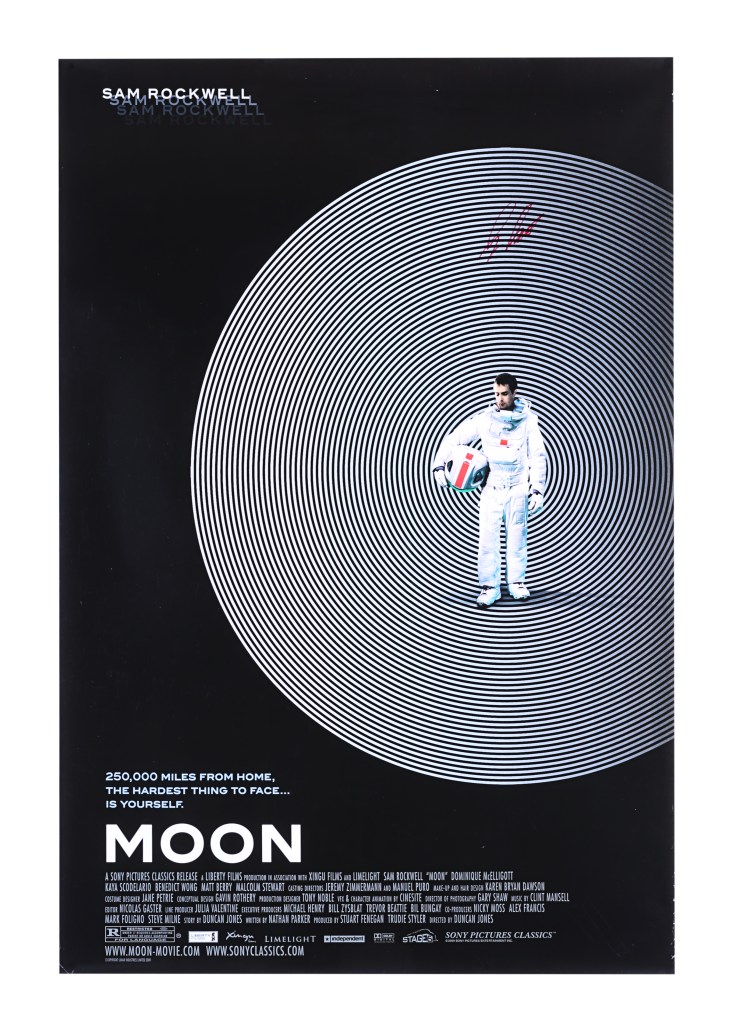
That’s the question that begins this film and it not only sets the tone for the movie, it runs throughout the story without ever being stated again. As you watch, there is that question in the background…Where are we now?
Astronaut Sam Bell’s (Sam Rockwell) three-year contract at a lunar mine, where his only companion is a robot named Gerty, is finally coming to an end and he’s longing for his reunion with his wife (Dominique McElligott) and their young daughter Eve. Strangely, Sam’s health takes a sudden downturn. He suffers painful headaches and hallucinations, and as a result, has a near fatal accident. When he is rescued by what looks like a slightly younger version of himself, it raises questions neither Sam has answers for. Can they solve the mystery before time runs out?
***THIS REVIEW CONTAINS SPOILERS***
Do nothing from selfish ambition or conceit, but in humility count others more significant than yourselves. Let each of you look not only to his own interests, but also to the interests of others. – Philippians 2:3-4 (ESV)
Sam Bell is having a crisis. His circumstances are unique, but his crisis really isn’t. It’s one we all face over and over again in our short lives…
Where are we now?
And, WHO are we?
Sam thinks he’s the husband of a lovely woman and the father of a little girl. He thinks he’s a dedicated employee of a company that mines lunar rock they convert into energy back on earth that has helped create a kind of utopia.
But Sam is really a clone.
He just doesn’t know it yet.
The original Sam Bell has been back on earth for nearly fifteen years, his wife is dead, his daughter is a teenager, and he is living comfortably while his clones complete a continuous run of three year contracts at the end of which they get to “go home.” That means they are vaporized and a new clone is awakened thinking they have only just arrived and it’s time to begin their three year contract.
Why three years? Because that’s the lifespan of a clone. The genetic sequencing begins to break down and the clone gets sick, begins to fall apart and die.
This has been going on for years and only the AI robot Gerty and the company owners know the truth until the current Sam is rescued by his replacement.
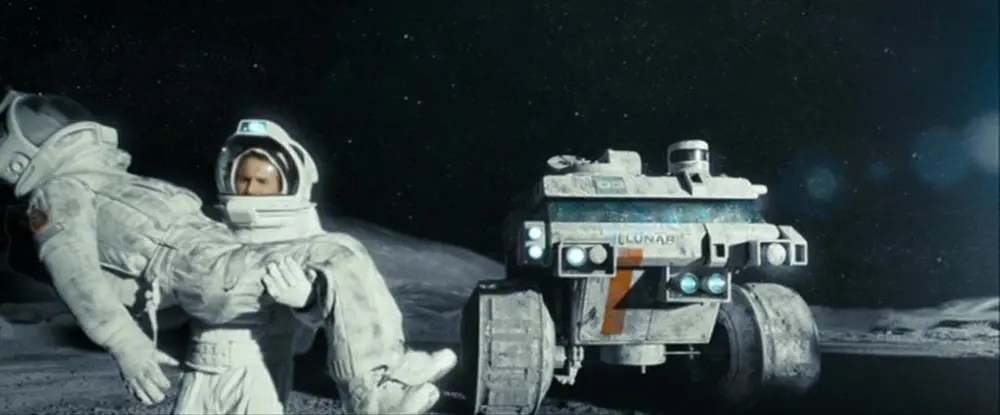
Part of the breakdown of the clones is having hallucinations. When Sam has one in a rover as he is approaching a mining vehicle, he crashes and is knocked unconscious and the mining vehicle becomes inoperative. Gerty activates his replacement and notifies the company officials, who dispatch a rescue team.
The new Sam, ever the dedicated employee, wants to fix the mining equipment. That’s when he finds and rescues…himself.
There’s a wonderful scene when New Sam is looking at Old Sam as he lies in the sickbay recovering from his accident. New Sam is suspicious and angry and Old Sam, who thinks he’s hallucinating again, asks Gerty, “Is there someone else in this room with us?”
At first, the pair of Sam’s ignore one another. There is a sense of denial. If I don’t acknowledge this other me, then I don’t have to deal with the questions that inevitably follow. SO MANY QUESTIONS.
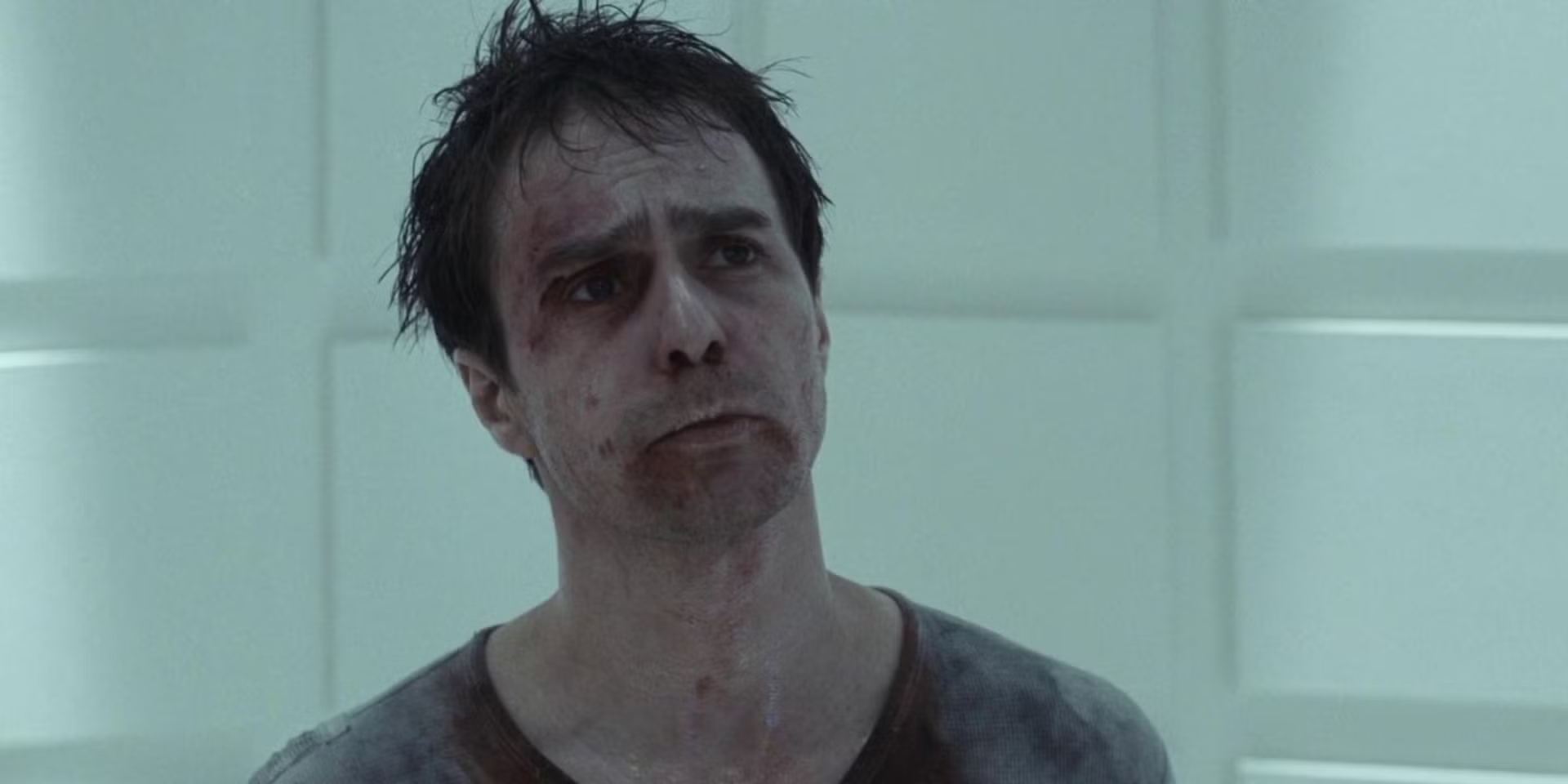
But there is something that overcomes Old Sam’s reluctance to engage…loneliness. Three years is a long time with no contact with another human being and only recorded messages from your wife back home. And loneliness changes people.
New Sam is brash, angry, focused, and disconnected. Old Sam has been tempered by time and loneliness. He’s gentler, kinder, and longs for connection, which New Sam will not provide. He won’t even shake Old Sam’s hand.
When they finally do begin speaking to each other, New Sam has already worked out that that they are both clones while Old Sam insists he is the original. When he discovers that New Sam is correct about who and what they are it is Gerty that confirms it.
In a beautiful performance by Rockwell, you see Old Sam’s entire sense of self come crashing down and the only one there to “comfort” him is Gerty, the machine. The sense of loneliness and now despair is intensified.
As the truth of their situation is realized and accepted, the Sam’s question everything, especially the live communications blackout the company keeps claiming they will fix. They go on the hunt and discover jamming towers. Old Sam drives a rover out past the jammers and uses a communication device to contact Original Sam’s home, where he sees his now 15-year old girl and learns of his wife’s death.
He shuts down the call, looks toward heaven and in lament says, or is it that he prays, “That’s enough. That’s enough. I just want to go home.”
Both Sam’s realize time is short because the rescue team sent by the company is really a kill squad. If they find two clones active at the same time, they both die. But there is something else besides loneliness and isolation that can temper and change a person and that is companionship and walking through pain and loss with another. New Sam is no longer the selfish and angry man he was when he was activated and he has a plan to send Old Sam home.
They activate a new clone, which they will kill and place in the crashed rover. Then Old Sam will make the three-day journey back to earth. He’s fulfilled his contract. It’s time to go home. Of course, they both realize there is no “home” not for them. That goes unspoken, though. It doesn’t seem to matter. The fact that they are clones does not diminish their feelings of significance and meaning.
As New Sam reminds Gerty when the robot says that he and the next clone will resume their “programming”, “We’re not programming. We’re people. Do you understand?” Gerty does not understand. But we do.
As New Sam lays out the strategy for sending Old Sam home, there are a couple of problems. First, Old Sam is dying. He cannot make the trip. Secondly, neither one of them are killers. For the plan to work, the newly activated clone must be killed and placed in the rover. That is not going to be possible for either of them to do. The only solution is for Old Sam to go back into the crashed rover and die alone and for New Sam to make the journey back to earth.
There is a touching scene as the two of them sit in the rover and reminisce about meeting their wife and falling in love. They know the memories are implanted. They did not experience those things themselves, but again, there is no sense that this diminishes the memories of it for them or the power it had to shape their lives.
As the corporate kill squad arrives, New Sam is blasting off toward earth cheering and Old Sam watches his shuttle streak across the sky. He closes his eyes for the last time, they are both free.
Why I Recommend This Film
Artistically speaking, the film is powerful and beautiful in its simplicity. Sam Rockwell is one of the most underrated actors in show business, and, as always, he gives a wonderful performance. Not to mention the technical achievements of watching him interact with himself as another character.
But there are deeper things to consider here.
In Moon, we see the value and significance of people. We are not programs or employees or assets or tools. We are human beings and as Christians, we see ourselves and others as image bearers of our glorious and loving creator. There is dignity in that. This film connects us to the humanity of the two Sam’s and in that empathy we feel for them, we can question our own vision of others. Do we see the people in our lives as means to an end? Do we see them as servants to our agendas? Are they obstacles or tools in the accomplishment of our goals?
Where are we now?
There is also the question of how we respond to truths revealed about ourselves and our world. What happens when closely held truths turn out to be lies? What happens when our sense of self is shattered? How do we respond to it all? Who do we become after that? And what is it that changes us? Is it the event itself, or is something greater at work?
Where are we now?
This film also leads us to question the age-old refrain of the oppressors who justify their oppression with, “It’s for the greater good.” As Moon begins we see humans destroying the planet and the company’s clean energy solution from lunar rock mining providing clean and sustainable energy for 70% of the globe. Isn’t it noble? Isn’t it grand? We no longer treat the earth as a disposable product, we created disposable people instead. But it’s for the greater good.
Where are we now?
For Reflection and Discussion
What is true, good, and beautiful in this film?
As Christians, what can we Receive from this film? What can we Redeem? What must we Reject?
What does Moon tell us about what it means to be human? How does this compare or contrast to what Scripture teaches us it means to be human?
If you woke up tomorrow and discovered you were a clone, one of many, what do you think this would do to your sense of self? Does that tell you anything about where your sense of self is located?
As Christians, we believe that our sense of significance and value comes from Christ. How do you live out that belief in the way you treat yourself and others?
Are there any relationships in your life you view as “disposable”? What needs to change in your view and treatment of those people?
For everything there is a season, and a time for every matter under heaven…a time to keep silence and a time to speak. (Ecclesiastes, 3:1,7)
Years ago, when my now grown sons were children, I took them on a homeschool field trip in the Fall to a Civil War historic site. There was a walking trail with multiple stops along the way where you could read about what took place during the battle.
We made our way together along the trail and they took turns reading to us about the events of the battle and we would stare for a moment and try to imagine what it may have looked like before we moved on.
When we climbed a hill I noticed something in the trees and directed my sons to sit down on a bench conveniently placed in front of what I hoped they would see a short distance away.
We sat and I said nothing and, as young boys do, they quickly grew bored and wanted to move on. I asked them to be still and be silent and just watch.
A moment later, my oldest son gasped and pointed through the trees. His brothers were soon gasping and pointing as well as a tree that looked like it was covered in golden leaves suddenly came to life as hundreds of Monarch butterflies spread their wings and began to fly away from its branches leaving them nearly barren. It was truly a beautiful sight and one I will probably never see again.
That sight is what my boys talked about the most over the next day or two. But we all would have missed it if we had not been silent and still.
About this time last year, a friend and I visited a Makoto Fujimura exhibit just a couple of hours from where I live. My favorite piece was one called “Silence” inspired by the novel of the same title by Shusako Endo. The picture below does not begin to do it justice.
We were invited to sit in front of the massive work of art in silence to enjoy it. I have extreme hearing loss so I turned off both of my hearing aids, which reduces me to only 25% of my hearing, and sat in literal silence before that painting.
At first my mind was racing with images I thought I saw and patterns and meaning and then I tried to quiet all of that and just sort of let the beauty of it wash over me. I didn’t try to empty my mind or anything, I just tried to notice and be aware and let the thoughts come without trying to force them.
I am thankful to God for that experience. For BOTH of these experiences. They are a reminder to me that there is a time for silence. There is a time to be still and quiet and open to whatever God wants to do in that moment, even if he is silent himself.
I think we all know there is “a time to speak” but I think we forget that there is also “a time to keep silence.”
But we live in a culture that majors in distraction and noise. It’s everywhere we look. It’s loaded into the device in our hands that is now essentially an extension of our bodies.
Life has been so hectic lately, so stressful, with so many things to do and places to be and things to pay for and goals to achieve and projects to complete. I feel overwhelmed.
Do you?
What I long for is some silence. To just sit with God in a quiet place and see what he will say. Or just sit with God in a quiet place and know I am beloved even when he says nothing.
Why is that so hard for us to do? And I don’t mean finding time to do it, I mean the act itself is hard.
When was the last time you tried to just sit in complete silence for a while?
But what are we missing by chasing and saturating ourselves with noise?
That’s what Jeffrey Overstreet‘s high school English teacher taught him about poetry and literature and films and art and he has carried that lesson with him as a movie critic and author and teacher.
Objects and words and images have meaning. Sometimes the creator uses them intentionally to convey specific ideas or truths, and at other times, the meaning is personal to the one who is engaging with the art. The work speaks to us in ways the creator may never have intended, but we get the message nonetheless.
Years ago, I visited an Annie Leibovitz photography exhibit at the High Museum of Art in Atlanta. I only remember one portrait. It’s the one in the White House of members of the Bush Administration’s war time cabinet. Something in that portrait jumped out at me and I couldn’t take my eyes off of it.
It was a band-aid on the thumb of Donald Rumsfeld.
The way his hand is positioned in the portrait told me I was MEANT to see the bandage. Leibovitz seemed to be saying “look at this!”
Here was this huge portrait of some of the most influential and powerful people on the planet at that time and one of them had a boo-boo. The meaning, to me at least, was that these are human beings, just like me. They are fallible and weak and easily injured, just like me.
It was a powerful experience with art and one I hope I never forget.
As a Christian, I believe that Scripture is the only infallible source of authority for faith and practice. I also believe God’s voice can be heard in art and nature and through others. God, the ultimate Creator, speaks through the creations of his image bearers. But we have to be curious and we have to engage and we have to slow down and pay attention. We have to remember that things mean things and that requires something of us, some effort to discover the meaning.
Works of art, whether a novel or painting or a play or anything else, has an impact on the way we see ourselves and the world and maybe even God. As Paul Klee says, “Art does not reproduce what we see; rather, it makes us see.” And I would add that it broadens and deepens and changes what we see and HOW we see.
But we have to pay attention.
In his excellent book, THROUGH A SCREEN DARKLY, Overstreet talks about “the God Room”. That’s what Hollywood people call the room where they meet with the Christian journalists and movie critics. At first it was an insult but those who have been in the God Room with these believers have discovered that they often have the deepest and most profound conversations about art there.
That’s because Christians see the world differently. We are looking for God and truth in what we see on the screen and when we see it, we point it out and ask meaningful questions about it. And in doing so, these Christian film critics have often shown the artists themselves something they didn’t realize was in their own work.
When was the last time you engaged art looking for the voice of God?
In our hustle culture we are rarely where we are, we are almost always where we are supposed to be next.
We are having lunch with a colleague but we are thinking about our next meeting.
We are talking with our spouse but we are thinking about the project we need to finish.
Our kids are telling us about their day but we are thinking about the game we are missing on TV.
In her book, IF YOU WANT TO WRITE, author Brenda Ueland calls this living in our destination.
We are not present where we are, we are living where we are supposed to be next. And in doing that, we never experience anything. We never arrive anywhere.
What are we missing? More importantly, WHO are we missing?
A concept I have been thinking a lot about as I write my next book is that love lingers. When we truly love someone, they have our full attention in the time we are with them. We are not in a rush to get to the next thing, we are there, in that time with that person.
I have a friend who is dear to me and we’ve had trouble recently coordinating our schedules to get some time together. One afternoon he had window of time between meetings.
I said no. Not because I didn’t want time with my friend, but because I didn’t want to be rushed. And I told him that. He agreed with me.
If we had met, he would be living in his destination, and I would have been living in his destination too because I would be thinking about how he had to leave soon to get to his next appointment.
It takes discipline to be in the present moment with others, but it’s worth it. If you want to build real fellowship and community. You must linger.
The Institute on Aging conducted a study on the Top 5 Regrets of the Dying and here is how the doctor who conducted the study summarized their findings:
It all comes down to love and relationships in the end. That is all that remains in the final weeks — love and relationships.
The next time you are with someone, anyone, try to be in that moment with them. THAT is your destination, not what’s next, but right there, with them. It will be uncomfortable, and it will take practice, but it will also be worth it.








 Joseph McBee