My fifties have been really good to me and God has blessed me beyond what I could have asked or imagined especially considering that in my forties I went through a devastating divorce, my dad died, and I had some major health issues that nearly cost me my legs and put me in the hospital for over a week.
And that’s just the highlight reel.
Now, in my blessed, happy, and relatively healthy mid-fifties (I’m working on making it my REALLY healthy fifties), it is even clearer to me that I have far fewer days ahead than I do behind.
What will I do with them?
All of our days are quite literally numbered by God (Psalm 139:16) and we have no idea what that number is. I think it’s good to live with that awareness.
Our finitude can set us free and make us bolder.
Besides, it’s arrogant to think I will always have time to change, to get healthy, to pursue my goals, to serve others, to launch that business, to write those books. I’ll just do it next year, or the year after that.
How do I know?
We don’t control the number of our days, but we are responsible for how we live the days we are given.
This reality has been hitting me hard. In a good and motivating and inspiring way.
So, this old dog is going to learn some new tricks and try some new things.
There are dreams and desires that I’ve had on the shelf for far too long. I’m taking them down, dusting them off, and getting to work.
I’m not putting anything off until “someday” because only God knows how many days I have and I want to be faithful to just flat out go for “it”, whatever that may be, for all the days I have and do it in such a way that God is honored.
Is it too late for some of them? Absolutely not.
The way I see it, I have fifty-five years of life experience, knowledge, and wisdom(ish) to help me win. Not to mention family and friends who love me and want to help me and cheer me on.
And if I do fail–and surely I will at times–so what? That’s just one more life lesson to log that will make me stronger and smarter so I can move forward.
I want to finish my race strong and exhausted and full of joy. Whether that is this year or, God willing, thirty years from now.
So, for the first time in several years I am setting some goals and some resolutions and I am excited about that. I have chosen to keep them private. But I have set them and I am committed to them. And I am excited about putting in the work to see them done.
But at the top of my list of goals is this line from James 4:15…
If the Lord wills, I will live and do this or that…
I have agency, but I am not sovereign. And I am thankful for that. I believe in and belong to a good, gracious, kind, and sovereign God. I may plan my way but it is God who establishes my steps (Proverbs 16:9).
But while I am not sovereign, I am responsible. And as I celebrated my 55th birthday this month I was reminded again that there are far fewer days ahead of me than there are behind me. If I live to the Biblical age of 75, that’s only twenty more years and I am responsible for how I live them.
By God’s grace, I want to make them count. I want Him to be glorified. I want to be a blessing to others.
So for me there is power in the New Year and I am excited about and thankful for 2026.
This is my final Reading Roundup for 2025. What a great year of reading it has been!
This month I finished 7 books for a total of 71 books for the year.
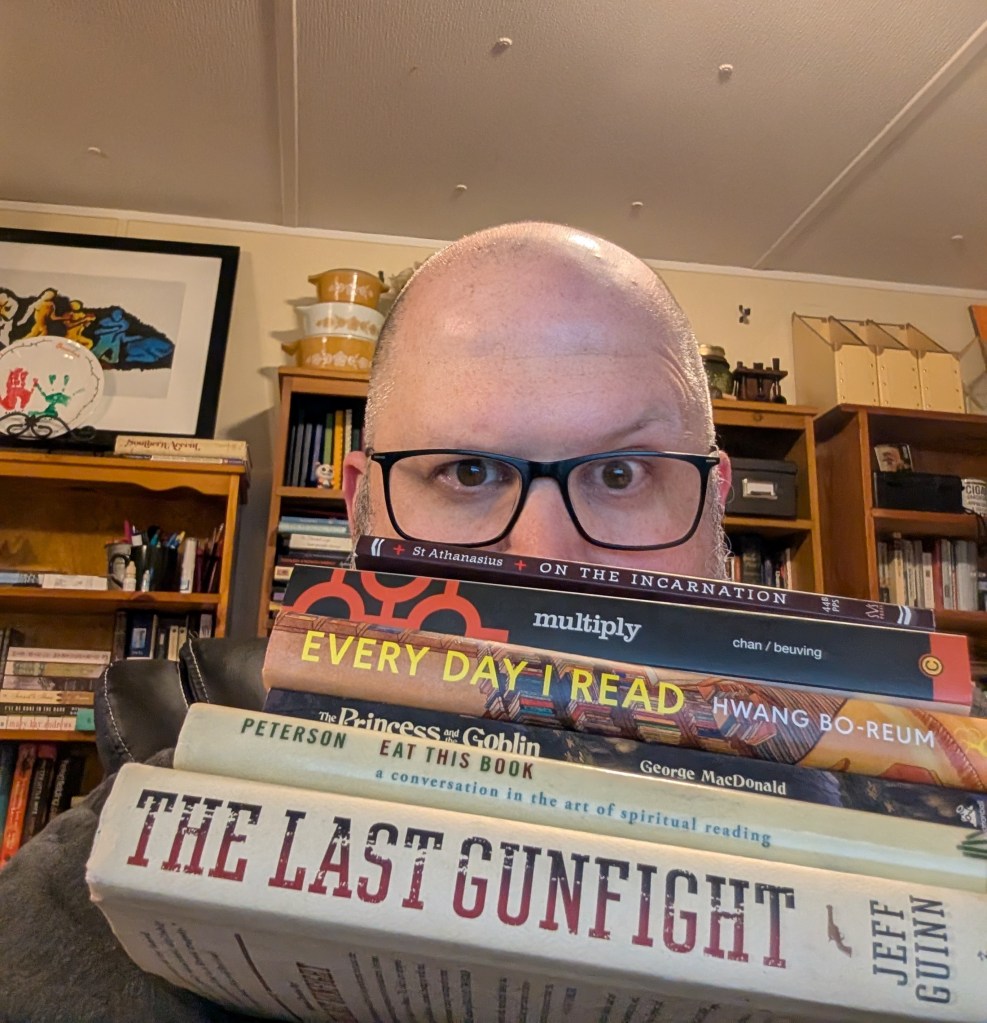
On the Incarnation by Saint Athanasius is one I read every year in December and every year I find it refreshing and beautiful and every year I love Jesus more because of this timeless book.
Multiply by Francis Chan is a helpful book for those who are baby Christians even if they have been in the church for a long time. I feel like the title is a little misleading. It looks like a book about how to evangelize, or how to disciple others but really, it’s a primer on how to grow in your walk with Christ. And in that way it is really good.
Every Day I Read by Hwang Bo-Reum is essentially a collection of love letters to books and reading. I enjoyed it and that’s really about it. There’s nothing revelatory here. There is nothing deep or incredibly powerful. It’s a nice book. If you love to read, you’ll enjoy the writing of someone who also loves to read. But if you don’t already love to read, I don’t think this book would make you fall in love with it.
The Princess and the Goblin by George MacDonald is the first book I have read by the man C.S. Lewis called “his master” in writing. And if you are familiar with Lewis’ work, you can see MacDonald’s influence in it. This book was written as children’s fantasy when that genre was first beginning. It is no allegorical (like The Pilgrim’s Progress), but it is Christian and you can see MacDonald’s faith on display throughout. There is definitely an overarching moral of the story and it is simply that true royalty is based on behavior not title or bloodline. Even if you are from the working class if you display excellence of character you are just as much a princess or prince as someone from a royal family.
Eat This Book by Eugene Peterson is a re-read for me. The first two sections of the book are now loaded with flags, notes, and underlining, the third section I pretty much skimmed because it is primarily about his journey in creating The Message Translation, and I honestly had zero interest in that. However, the first two-thirds of this book on spiritual reading are worth the price of the book and are rich and helpful.
The Last Gunfight by Jeff Guinn is a well researched, engaging, and fascinating look at the infamous shootout at the OK Corral in Tombstone, Arizona. Guinn expertly defines the setting geographically, historically, and socially and introduces us to all the key players, and then walks us through the events that lead up to the 30 seconds that has spawned legends, books, and movies ever since. He pulls no punches and has no interesting in scrubbing away the unsavory bits of the lives famous men like Wyatt Earp and Doc Holliday. I thoroughly enjoyed this book and it has made an excellent edition to my library on the history of the American West.
The Affections of Christ Jesus by Nijay Gupta (Not pictured). Gupta is another “new to me” writer this year and I loved this rich and powerful book on the love of Christ in the writings of the Apostle Paul. My copy is LOADED with underlining and little flags and marginalia. I have set it aside for a bit and then I am going back to it and making notes in a learning journal because there is so much here you can’t just read it and throw it on your shelf.
Gupta writes with a depth of knowledge of the Scriptures and he also writes with a depth of love for God and His Word. He is one of those rare subject matter experts that understands that not everyone is an expert so while his writing is challenging, it is accessible. I found no trouble at all following him.
I also loved that this is not just a book of scholarship, although it is certainly that. It is also a book with encouragement, implications, and applications throughout. In that sense, it is richly pastoral.
2025 was an excellent year of reading for me. I was able to finish 70 books and I am thankful to God for books and for writers and for the ability to read and for the easy access I have to books of all kinds.
Here is a list of the 10 BEST Books I Read in 2025, plus a few honorable mentions.
If you are interested in taking a look at brief reviews of almost all of the books I read this year, you can find them under my monthly Reading Roundups.
10. Hideki Smith and the Omukade by A.J. Hartley
Look, I enjoy Hartley’s writing across the board. This author is creative, eclectic, original, and just fun to read, but this book in his Hideki Smith series is some next level writing. The first book in the series was good. This is better. And you don’t see that often enough in sequels.
Instead of recycling scenes, jokes, twists, and plot points that worked for him in book 1, Hartley masterfully builds on that book and gives his readers something that is familiar and yet brand new. This page-turner kept me so engaged I felt irritated if my reading got interrupted. And I stayed up past my bedtime more than once so I could finish “just one, two, three more chapters.”
*Note: This book is not pictured above because I loaned out my copy and it hasn’t made it’s way back to me in time for this post.
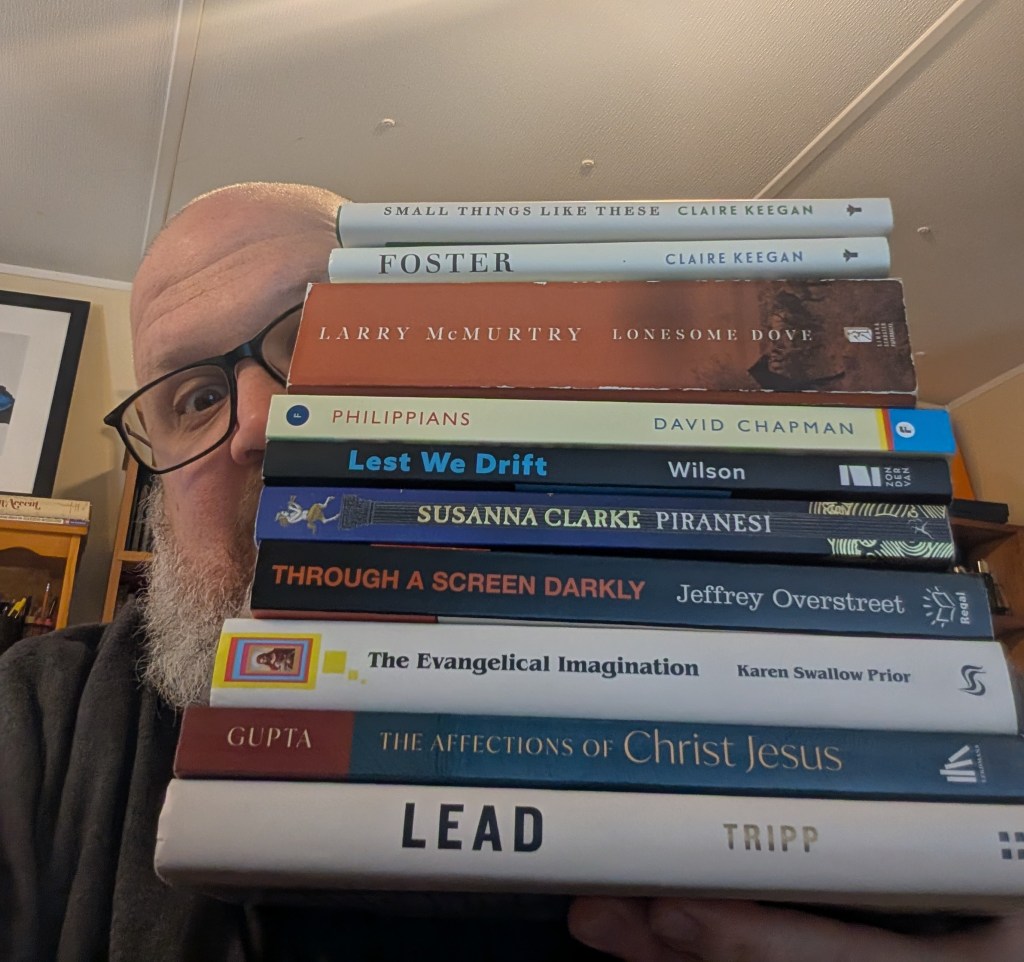
9. Piranesi by Susanna Clarke
This was my first Clarke novel. It won’t be my last. The world Clarke created in this novel is fresh and exciting and fascinating. Her writing can take your breath away with its beauty and make your soul ache because of the connection you have with her principle character. This is a fascinating tale and so original it sticks with you. I imagine that there will be books that will be along the same lines as this one and people will think, “Oh, that reminds me of Piranesi!” If you haven’t read Clarke before, I cannot recommend this book as an introduction to her work highly enough.
8. LEAD by Paul David Tripp
I haven’t always liked Tripp’s writing. In fact, I don’t think I would have read this one had it not been required by the leadership team I am a part of in my church. But this book was revelatory and powerful and has found its way onto my annual reading list. Not necessarily because it is fascinating and well-written, which it is, but because the lessons in this book are absolutely necessary for me to be reminded of and to internalize and live out and that is going to require repeated readings.
LEAD strikes that delicate balance between deeply convicting and encouraging. Tripp pulls no punches and some of them land squarely in your gut, but then he is quick to point you to the glorious truth of the gospel. It’s like every page is shouting, “Yes, you really are a mess! AND Jesus loves you and desires to work through you in the church.”
7. Philippians: Rejoicing and Thanksgiving by David Chapman
I know it seems strange to see a commentary on a top ten list, but this was just so good. This is the first commentary I’ve read from the Focus on the Bible series but if the rest are even half as good as this one, I want the entire series in my library.
This excellent exploration of Paul’s letter to his beloved friends is easily accessible by anyone–no seminary degree required–and yet the depth of scholarship underlying it will satisfy any biblical studies wonk. You don’t need to be working on a sermon or academic paper to enjoy this book. Grab a copy, your Bible, a journal, and a pen or pencil and just walk through Philippians with Chapman as your guide and you will blessed.
6. Through a Screen Darkly by Jeffrey Overstreet
I love movies and I loved this book about movies. You know how when you read a book you enjoy so much, you start slowing down as you get to the end because you don’t want the experience to be over? I’ve only ever done that with novels. Until this book. I seriously did not want Overstreet’s “cinematic memoir” to end. It is just too good.
Overstreet is a writer, film critic, and college professor and he writes with a love for God and for art that shows up on every page. I have always loved movies and I think about them deeply and, honestly, have often been made fun of by others for doing that. With this book, I felt seen. I felt less like an odd ball and more like there were others like me. There are people who take movies seriously as art and Overstreet is speaking to us as one of us.
At the same time, he is writing to anyone who enjoys movies. He writes from a Christian worldview, but I think anyone can learn to think about and enjoy films on a deeper level by reading this book. Oh, and my “To Be Viewed” list grew A LOT as I read.
5. The Evangelical Imagination by Karen Swallow Prior
The author masterfully builds a case piece by piece that reveals how much of the Evangelical faith we take at face value without considering where some of our most closely held beliefs come from and without realizing how many of these beliefs are built, not from Scripture, but from a shared social imaginary. This imaginary is comprised of the stories we tell, the images we absorb, and the metaphors we use to describe and understand our world.
Swallow Prior picks up a magnified mirror, holds it up to Evangelicalism, and says, “Look closely right here.” And when we do, we might find ourselves shocked, even a bit horrified, but if we are paying attention, we won’t be offended. The author is not holding up her mirror with an attitude of disgust or judgment, but with a heart of love and all she’s asking us to do is pay attention and think.
Let’s stop taking everything at face value. Let’s stop absorbing sound bites and spitting them in the faces of others. Instead, let’s ask questions, pray, discuss, and just think.
I found as I read the book that I was asking many questions about my own beliefs and their origins and in those questions, I was drawn to a deeper faith in Christ. If that doesn’t make it worth reading, I don’t know what does.
Jared Wilson has written many gospel-centered books. This is not his first, and God willing it won’t be his last. But out of all the ones I’ve read so far, and they have all been good, this one in particular stands out.
Wilson writes with the mind of a theologian, the heart of a pastor, and the passion of someone who knows he is a great sinner in need of a great Savior. In fact, he is very open and honest about his own weaknesses and the ways he has drifted from the gospel and the consequences that came with that and how the gospel of Jesus Christ was and is good news to him.
As Wilson shows us in this book, it’s so tragically easy to drift away from the good news of Jesus into other things, even important and good things, and point to them and say, “this thing is of first importance” and when we do that, we are missing it. We are missing where true life really is and we are pointing others away from Jesus too.
Wilson’s writing in LEST WE DRIFT packs some punch in a lot of places. But while Wilson writes strongly, there is no harshness in the way he writes it. The strength of his words are based in love for Jesus and for the people of God. You may feel convicted but you won’t feel condemned.
I think, LEST WE DRIFT is a timely and beautiful book. I was more in love with Jesus after I read it, and I also felt more aware of the ways I have often drifted away from the gospel in my own life. But I didn’t feel ashamed. I felt invited back to the heart of God.
3. The Affections of Christ Jesus by Nijay Gupta
Gupta is another “new to me” writer this year and I loved this rich and powerful book on the love of Christ in the writings of the Apostle Paul. My copy is LOADED with underlining and little flags and marginalia. I have set it aside for a bit and then I am going back to it and making notes in a learning journal because there is so much here you can’t just read it and throw it on your shelf.
Gupta writes with a depth of knowledge of the Scriptures and he also writes with a depth of love for God and His Word. He is one of those rare subject matter experts that understands that not everyone is an expert so while his writing is challenging, it is accessible. I found no trouble at all following him.
I also loved that this is not just a book of scholarship, although it is certainly that. It is also a book with encouragement, implications, and applications throughout. In that sense, it is richly pastoral.
2. Foster AND Small Things Like These by Claire Keegan
Okay, I know this is cheating a little, but I really could NOT pick one over the other. Both of these books are wonderful and as a result of reading them I am in love with Claire Keegan’s writing and will faithfully read everything she writes from now on. There is so much beauty and simplicity and excellence in these stories that I felt like a richer and better person for having read them. Keegan is a true master of the craft of writing. She’s the kind of writer that readers love AND the kind of writer that other writers admire. You don’t often find that in the same person.
If you haven’t read Keegan’s work yet, just do it. Both of these books are a wonderful place to start. Pick one and read it. Then come back here and leave your appreciative comments on this post.
And I will just offer a preemptive, “you’re welcome.”
1. Lonesome Dove by Larry McMurtry
Duh.
I mean, can this book appear on any top ten list and NOT be in the number one spot?
When Robert Duvall accepted a Lifetime Achievement Award from the National Cowboy & Western Heritage Museum, he highlighted the Western as America’s unique cultural contribution with this quote:
The English have Shakespeare. The French have Moliere. What do we (Americans) have…the Western!”
Of course, Duvall played Gus McCrae in the TV miniseries of this book and when I read Lonesome Dove, I could hear Duvall’s voice in my head.
When has this not been a famous and continuously read epic?
After reading this book, I had to set it aside for a moment and mourn the loss of a group of characters I had fallen in love with over the course of 858 pages. I was sad that my journey with them was over. And what a journey it was!
I absolutely love Western novels and the history of the American West and read both frequently. But this one is not only my favorite Western, it is one of my top 5 favorite novels. The rich characters, the converging plotlines, the high stakes, the adventure, the sheer scope of the novel is just incredible.
Honorable Mentions
Here are few titles that nearly made the top 10 this year.
Ancient Wisdom for the Care of Souls by Coleman M. Ford and Shawn J. Wilhite
One of my favorite things about this time of year is the release of so many “Best Books” and “Favorite Reads” lists! I will do my own of course, but here are some links to some good lists.
Tim Challies’ The Collected best Books of 2025. There is one book on here I am continually amazed ends up on the best books lists. He also has a list of the sources he used to make the selections.
If you were to create your list, what books would be on it? They don’t have to be published this year, only read this year.
I’ve created a ridiculous, outrageous, and impossible reading plan for 2026. Seriously, there is no way I will complete it. No way.
But I don’t care.
I get excited about books and reading and I enjoy making plans and setting targets and keeping records and all those sorts of things.
I understand that the plan I have created is unrealistic, but I just can’t help myself and if I even hit the halfway mark it’s going to be an incredible year of reading!
The Structure
I’ve set the plan up according to categories and then subcategories. The number of books in each category is based on my personal interests and needs.
Here is a list of the major categories:
Annual Bible Reading Plan: I read the Bible through each year so this is always on the list.
Daily Devotions: There are only 2 books on this list. They are year-long devotionals at about a page or two a day.
The Daily Trio: This is a new thing I started this year, where I try to read 1 short story, 1 essay or sermon, and 1 poem each day.
Reading it Again
Spiritual Formation: There are books about what I call “Active Theology” (a term I prefer to Christian Living), Christian Spirituality, and the spiritual disciplines.
Ministry
Book Club: These are the selections our club chose to read in 2026.
Novels
Classics
Reading Projects: This is a summary of multiple categories like Steinbeck, McCarthy, Shakespeare, L’Amour, etc.
Favorite Writers: This includes authors like Muriel Barbery, Alan Jacobs, Jessica Hooten-Wilson, Jasper Fforde, Susanna Clarke, and Claire Keegan.
Children’s Literature
Hot Off the Presses: These are books published in 2026.
Plays
Current WIP: WIP = Work in Progress. This is research material for the new book I am writing.
Writing Craft
History
Biography
Commentaries: These are just for my personal edification and learning. After I read the Bible through (in the first 90 days) I do deep dives into specific books or topics in Scripture. For 2026, I am going to dig deep into the books of Hosea, and 1 and 2 Peter.
Theatre Studies and Film Studies
Theology
Biblical Studies
Major Works: I have chosen four books that are pretty massive and that will take a while to read, so I hope to finish one each quarter.
Education & Learning: A subject that is a personal passion.
Recommended by Others
Just for Fun: This includes things like Westerns and fantasy. Total brain candy.
Annual Reads: These are a few books on my list every year.
Just Because I want to Hit the Magic Number
And what is the magic, impossible number?
350 BOOKS!!!
Yeah, yeah, I know. You’re laughing at me. I’m laughing at myself. But I am going for it and we’ll see how close I can get to the target.
Check in periodically to see how I am doing. It’s going to be a great year for reading!
I finished 11 books in November for a total of 64 so far this year so it was an excellent month in the stacks!
Lead by Paul David Tripp is a book I have been discussing with a group of guys from my church. It strikes that delicate balance between deeply convicting and encouraging. Tripp pulls no punches and some of them land squarely in your gut, but then he is quick to point you to the glorious truth of the gospel. It’s like every page is shouting, “Yes, you really are a mess! And Jesus loves you and desires to work through you in the church.” As we have discussed this book, there have been some tears and a deeper desire to stay close to Jesus as we work to serve His people. This book is going on my annual reading list.
Spiritual Direction for the Care of Souls edited by Gary Moon was more academic than I anticipated and I got a lot out of it. This book covers the major traditions like Catholic, Orthodox, Methodist, Reformed, and Pentecostal and explores how they approach the ministry of spiritual direction in soul care. Each chapter provides an overview of that tradition’s approach, highlights some practices within the approach, and discusses its interactions with psychotherapy. It was an interesting read and while a couple of the approaches aligned far more with my theology, there were others that resonated with me at least in part and I was grateful to learn from them.
A Christmas Carol by Charles Dickens. I cannot believe I’ve never read this before! I think it must be because I approached it with a child’s mind of, “This is going to be dull!” It was anything but. I was moved to tears when I read about the redemption of Scrooge and the clear and immediate evidence of his transformation and how the joy he experienced was only made complete when it was shared with others. All Biblical stuff. I read this one for book club but I am adding it to my list to read each December.
Hideki Smith and the Omukade. Welcome back to Portersville, the sleepy town in the mountains of North Carolina and home to Hideki Smith and his sister Em, and to a prison under a mountain filled with monsters from Japanese folklore. Oh, and some have escaped!
A.J. Hartley brings us back to the heroics of the “loser” Hideki, his newly discovered powers, and his sister’s ability to transform herself into a fox as they are once again called upon to perform the thankless job of saving the lives of everyone they know!
I enjoyed the first book in this series and this one is even better. Hartley is able to do more with the cast of interesting characters he established in Hideki Smith: Demon Queller, and the writing itself feels richer and deeper and even personal. Not just for Hartley, but for us as readers too. We know these people. We ARE these people.
This is not just an adventure story with battles, monsters, magical beings, mystery, thrills, and quite a few chills. And it has plenty of that.
It is also a story about love and family and rejection and loss and community and connection and trying to figure out who you are and where you fit in and all the things that make up rich, full, and challenging lives.
Don’t be surprised if you lose some sleep staying up reading this and don’t be surprised if you laugh out loud, shed a few tears, and even shout in triumph and terror.
This is a “just one more chapter” page-turner of a book. It’s one you can get lost in and it’s one you’re thinking about days after you’re done.
The Steadfast Love of God by Sam Storms was not what I was hoping for and I think that may warp my opinion a bit. It read like a series of transcribed sermons, which is fine, but I am used to far more theological meat from Storm’s books. This one was more pastoral. There are a few chapters where I have massive amounts of underlined passages and others that looked like I skipped over them.
Foster by Claire Keegan was fantastic. I read this one for book club and have fallen in love with Keegan’s writing. I will faithfully read everything she writes for as long she practices her craft. The depth she can go to with such economy of words is a massive gift that so few possess. And it seems to me that her writing is crafted with a love for language and story and for her readers. Keegan is the kind of writer you celebrate.
Small Things Like These by Claire Keegan is another one I loved for all the reasons I loved FOSTER and more besides. There is a weight to this book and it grows on you as the story advances. You can feel an inevitability in it. You know it is working toward an ending that you will carry away with you. I am going to read this again. In fact, I am going to study it. Keegan’s writing is a master class in craft.
The Singer Trilogy by Calvin Miller is collection of poetry in the tradition of C.S. Lewis, or so the book blurb goes. I can see how it was inspired by Lewis, but this is something different. The trilogy is a retelling of the New Testament with the first volume being about Jesus, the second is about the growth of the church, and the third is about the end of all things. It felt a little heavy handed in places and in others there was far more depth. I don’t know if I would call this “good” but it was interesting. And I enjoyed the art work.
The Songs of Jesus by Timothy Keller is a year-long devotional through the Psalms, in which Keller constantly points to Jesus, which of course, I loved.
On the TBR Stack
Here is what I am reading as I finish out the year:
On the Incarnation by Saint Athanasius
Multiply by Francis Chan
The Last Gunfight by Jeff Guin
The Princess and the Goblin by George MacDonald
The Affections of Christ Jesus by Nijay Gupta
The Complete Short Stories by Flannery O’Connor
Letters and Papers from Prison by Dietrich Bonhoeffer (this will probably carry over into January)
The Complete Poems by Langston Hughes (ditto on this one)
On this, the last day of October, I celebrate Fall, my favorite season of the year, with one of my favorite poems.
A Vagabond Song by Bliss Carman
There is something in the autumn that is native to my blood— Touch of manner, hint of mood; And my heart is like a rhyme, With the yellow and the purple and the crimson keeping time.
The scarlet of the maples can shake me like a cry Of bugles going by. And my lonely spirit thrills To see the frosty asters like a smoke upon the hills.
There is something in October sets the gypsy blood astir; We must rise and follow her, When from every hill of flame She calls and calls each vagabond by name.
I finished 7 books this month for a total of 53 so far this year.
I’ve had the honor of preaching some of the sermons in our series at church on Paul’s letter to the Philippians so I finished reading 4 commentaries on that beautiful letter.
The Epistle of Paul to the Philippians by R.P. Martin is from the Tyndale series. The very first commentary I ever owned was from Tyndale and I have always appreciated their concise and accessible format and writing style and this one was no exception. No matter what book of the Bible I am studying, you will likely find one of the Tyndale commentaries in my stack of study materials. I find them to be an excellent resource for personal Bible study as well as sermon prep.
Philippians: Rejoicing and Thanksgiving by David Chapman is from the Focus on the Bible Series and I thought it was excellent. I had not heard of the FOTB series of commentaries before I picked this up, but I will be adding all of them to my library if they are all this thorough and easy to read and understand. This volume was a cross between scholarship and devotional. You don’t need training in ancient Greek to understand it and yet the scholarship in it is rich. I highly recommend this one.
Philippians by Frank Thielman is from the NIV Application Commentary. It has been my experience that some of the NIV Application commentaries are better than others and this is one of the better ones. I like the way the whole series attempts to bridge the gap between what the Scriptures meant to the original readers and what they mean to us today. This one was more devotional than scholarship, and that’s fine. The only downside to this one was that it was sometimes hard to follow which verse the author was expounding on. Still, though, a solid resource.
Philippians by Dennis E. Johnson is from the Reformed Expository Commentary series. I love every volume of this series I have in my library. They are all excellent and Johnson’s volume on Philippians is right on track with all the others. This one is also a robust blend of Biblical scholarship and devotional literature. You can sit down and read these books straight through and be encouraged and convicted and walk away with a deeper understanding of God’s Word. I haven’t read them all, of course, but I wouldn’t hesitate to recommend any of them.
Encouragement: The Unexpected Power of Building Others Up by Larry Crabb and Dan Allender was a nice little book that was…well, encouraging. As Christians we are missing out if we are not seeking ways to encourage and build up our brothers and sisters in Christ. It is a way we can serve others, be active members of the church, and receive blessings ourselves. There are great blessings for those who encourage others, as well as those who are being encouraged. This book is a slim and helpful volume of inspiration and instruction on this kind of “every member a minster” work.
A Prayer for Owen Meany by John Irving. I think I want to write a longer review of this one. I have a lot of thoughts on it. This was my second reading of this book and it lands differently in a second reading. The writing is excellent and the story is captivating and the characters, every single one of them, are fully realized and stay with you long after you finish the last page. What interested me the most was the constant theme of the guiding hand of Providence even in those who do not believe.
Theo of Golden by Allen Levi. Okay, I want to be so careful here. I read this for my book club and many of them, and SO many others, absolutely love this book. I am not one of those people. I respect Levi for the work he put into this self-published novel, and apparently it has struck a chord with many people because it is hugely popular. In fact, I started to wonder what I was missing just based on its popularity but it just did not strike that same chord with me. I didn’t think it was well written or plotted and it was so sugary sweet I felt manipulated instead of moved. And I found the ending unsatisfying and a bit forced. I’m sorry to those who love this book and I wish the author all the best. This kind of thing just isn’t for me.
On My TBR for November
Here are some of the books I hope to finish next month.
The Emotional Craft of Fiction by Donald Maas
The Affections of Christ Jesus by Nijay K. Gupta
Spiritual Direction and the Care of Souls edited by Gary W. Moon and David G. Benner
Although I may not have articulated in this way, this bit from from James Marriott’s newsletter this week is one of the reasons why I restarted and continue to work at writing a blog and why I try to post my own stuff, lousy as it may be. It’s a desire to be more of a creator than a consumer.
Everything is television.
In an insightful piece by Derek Thompson, he argues that “a great convergence is happening” in the media. Everything is becoming television. In a recent court case Mark Zuckerberg’s Facebook argued that it is not really a social media company at all. People aren’t talking to their friends on social media the way they once did. Increasingly all anyone does on Facebook is watch short videos:
Only a small share of time spent on its social-networking platforms is truly “social” networking—that is, time spent checking in with friends and family. More than 80 percent of time spent on Facebook and more than 90 percent of time spent on Instagram is spent watching videos, the company reported.
Video is everywhere. TikTok, YouTube and Netflix are video apps, obviously. But so, increasingly, are Reddit and Twitter. Most successful podcasts now broadcast in video as well as audio. Meta and OpenAI recently announced they are rolling out “AI social networks where users can watch endless videos generated by artificial intelligence”.
Most of what people are doing online nowadays is watching videos.
On top of this the experience of using the internet is becoming increasingly passive. Where people once used social media to post their own pictures and interact with friends, it is increasingly the case that the vast majority of content on social media is produced by a tiny minority of influencers for whom posting online is a professional or semi-professional endeavor…Apparently, “94 percent of YouTube views come from 4 percent of videos, and 89 percent of TikTok views come from 5 percent of videos.”





 Joseph McBee