Perfect Days: A Film Christians Should Watch

There is nothing better for a person than that he should eat and drink and find enjoyment in his toil. This also, I saw, is from the hand of God. (Ecclesiastes 2:24)

I’m not sure how to begin writing about PERFECT DAYS. It is currently my favorite movie and I honestly think about it almost daily.

Maybe it landed in my life at a time when I was most open to its message.

Maybe it represents something I long for.

Maybe it’s the simplicity and beauty of the film itself.

I don’t know. I just know I love it and I recommend it to everyone I can.
***WARNING: This Review Contains Spoilers***

Hirayama’s Perfect Days

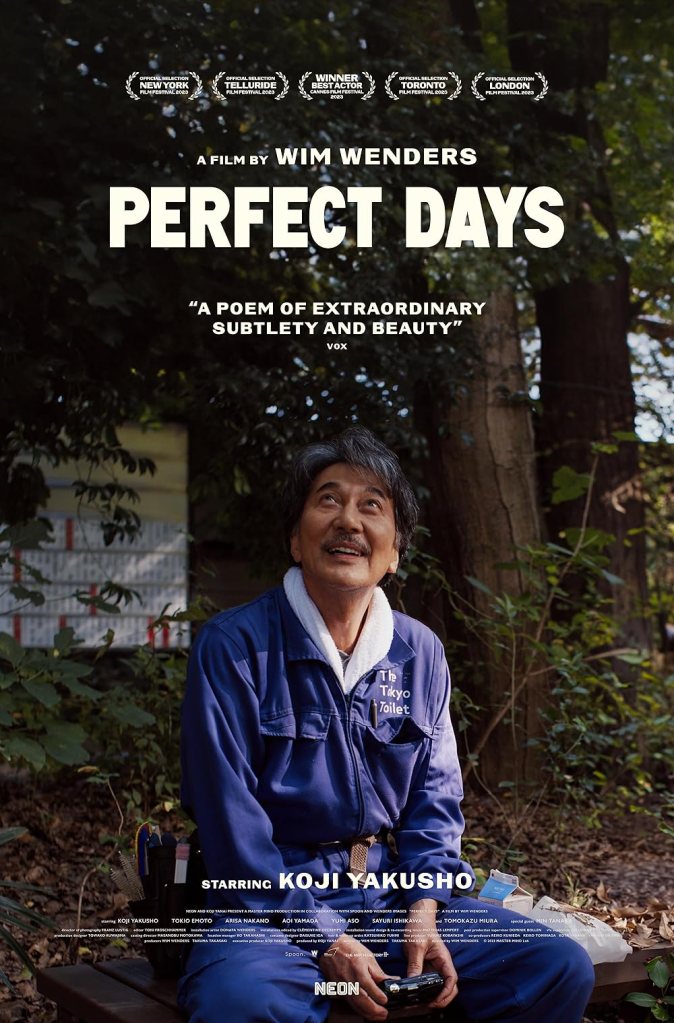
Hirayama (played masterfully by Koji Yakusho) feels content with his life as a toilet cleaner in Tokyo. He has a cherished and structured routine to his life, he cherishes music on cassette tapes, he reads books and snaps photos of a specific tree near a shrine where he takes his lunch everyday. Through unexpected encounters with the people in his life, he reflects on beauty and relationships and the stress of change.

Each of his days begin with the sound of a woman sweeping the streets in the early morning just outside his small apartment. As soon as he awakes, he folds up his bed, goes downstairs to brush his teeth, trim his moustache, and wash his face. He brings a spray bottle of water back upstairs to water his collection of trees he is growing in a small room. Once he sprays each one, he sits back to admire them for a moment. It is clear they make him happy.

We see him get dressed in his work uniform. “The Tokyo Toilet” is on his coveralls. He walks out the front door, looks up at the sky, smiles, and takes a breath that he lets out in a contended sigh. He is greeting the new day.

He gets a cold can of coffee from a vending machine, climbs into his van, selects a cassette to listen to, and starts off on his way to work, while the sun is just barely up.
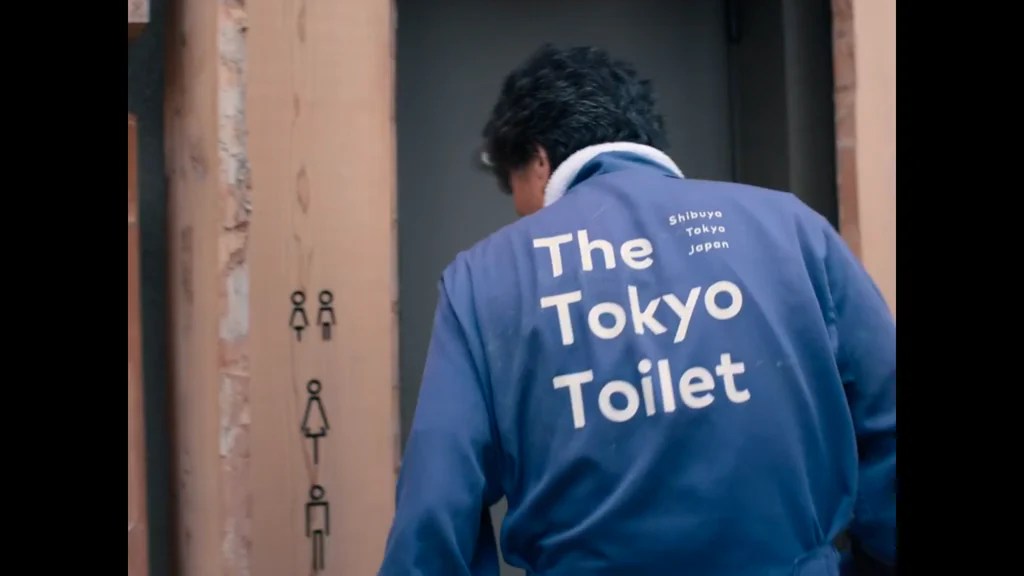
Hirayama spends his days cleaning public toilets. And he does his work with care and excellence. We see him picking up trash and wiping down mirrors and counters. We see him scrubbing toilet bowls and even taking a small mirror so he can see underneath the bowl and clean any spots he may have missed.

We are ten minutes into the film before we hear one line of dialogue and that doesn’t come from Hirayama, it is from his young assistant, Takashi (Tokio Emoto), who spends most of his time complaining and whining. A complete opposite to Hirayama who’s sense of peace becomes even more apparent in contrast to Takashi’s frantic nature. Takashi is not a “bad” person, he’s just dissatisfied with work, his love life, his finances, and just life in general.

We follow Hirayama throughout his entire day as he cleans bathrooms, bathes, has his evening meal, returns to his home and reads and then falls contentedly asleep and dreams simply of the things he saw and did that day and all the while the only sound track is the wind and the noise of the city, which is a constant presence throughout the film.
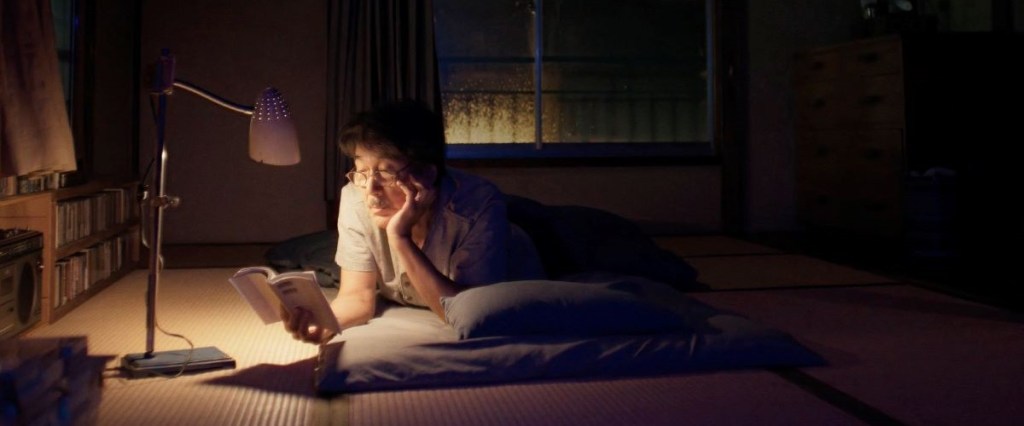
One of the regular features of his perfect days is eating his lunch beneath the same tree. He looks up at the tree and smiles and watches the dappled light shining through the crown and branches. The Japanese term for this effect is komorebi. He pulls out an old film camera and snaps a picture in black and white of the light dancing in the trees.

We see this theme throughout the film, the moments of beauty that are completely unique and ephemeral. They are things we tend to miss because we are too busy with other things, but Hirayama does not miss them. He is present and aware. Wherever he is, THAT is where he is.

On his day off his routine changes, but it is still routine. And that is not even the right word. His life is not routine, it is ritual. There is a deeper meaning to his habits.

He takes his clothes from the week to a local laundromat. He drops off a roll of film to be developed, picks up a new roll, and picks up the pictures from his last one. He sorts through the photographs and stores them. He goes to a small bookstore and purchases a new book, always from the $1 per book section. And he ends the day at a small restaurant where he is a beloved regular by the owner, a woman his age, who clearly enjoys his company.

One evening, when he returns to his home, he finds his young niece Niko (Arisa Nakano) waiting for him. It is clear to us that he has not seen her in quite some time. She stays with him overnight and goes to work with him the next morning. There is a tender scene Nakano plays with beautiful depth, where she is watching him clean a toilet and you can see that she feels shame for her beloved uncle. A young girl, probably not much older than Niko, shows up at the bathroom door and sees the man cleaning it and looks disgusted. Hirayama immediately leaves so the young woman can use the facilities and stands patiently outside.

As Niko looks at her uncle, feeling embarrassed for him, he looks at her and smiles. There is no shame on his face. He is not concerned with how other’s view him or the work he does. And then the shame on the face of his niece melts into a smile of admiration.
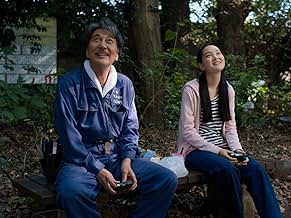
Later, as they ride bikes together through the city Niko speaks of her mother, Hirayama’s sister, and wonders why she and her uncle do not get along. “The world is made up of many worlds.” Her uncle explains. “Some are connected. Some are not.”

“Which world am I in?” Niko asks him. But he does not answer. That is her journey, not his.

As they stare out at the river, which runs to the ocean, Niko asks if they can follow it to the ocean. “Next time.” Her Uncle says. “When is next time?” Asks Niko. “Next time is next time. Now is now.” Is Hirayama’s answer. And Niko understands what we see over and over again. Be present. Be here. Right now. Be where you are. As they ride away, they sing it together, “Next time is next time. Now is now.”

Hirayama’s Not-So-Perfect Days

When they return to his home, Niko’s mother is there waiting for her daughter. She has arrived in a chauffer driven car and is smartly dressed. This scene is the only information we ever get about his history and it is obviously one filled with suffering.

As Niko goes inside to collect her things. Hirayama’s sister asks him to visit their father in the nursing home. She explains that he does not remember anything now so maybe he will be different. Hirayama refuses. His sister leans in and in a whisper asks, “Are you really cleaning toilets?” There is a pained expression on her face. Shame. Hirayama smiles and nods. Again, without shame.

When it is time for them to leave, his sister stands paralyzed. It is Hirayama that moves toward her for an embrace. And as they drive away, he weeps. But you get the impression that he weeps for his family more than for himself.

The next day, things seem to come unraveled. His assistant quits suddenly, blowing up Hirayama’s ritualistic day. Then, on his day off, he arrives at the restaurant to see the owner in an embrace with a man. He flees the scene and we see him purchasing beer and smokes, which he takes down to the river.

The man from the restaurant appears beside him and there is a beautiful conversation between them. The man is the ex-husband of the woman who owns the restaurant and he is dying of cancer. He just wanted to see her again before the end.

As they look together out at the shadows and light on the water the man wonders out loud if shadows get darker when they overlap. Hirayama does not know, but is delighted by the question.

“So many things I still don’t know.” The man says. “That’s how life ends I guess.”

Hirayama invites the man to figure it out with him. They stand together trying to see if their overlapping shadows get darker. Hirayama insists that they must get darker, but the man says he sees no difference. Hirayama comes to a realization. “So nothing is changing after all. It is all just nonsense.”

I don’t think he means life is nonsense. It’s that when the shadows begin to fall on our lives and they pile up, life does not become darker. To think it does is nonsense. Rather than trying to figure it out, the two men start to play shadow tag.

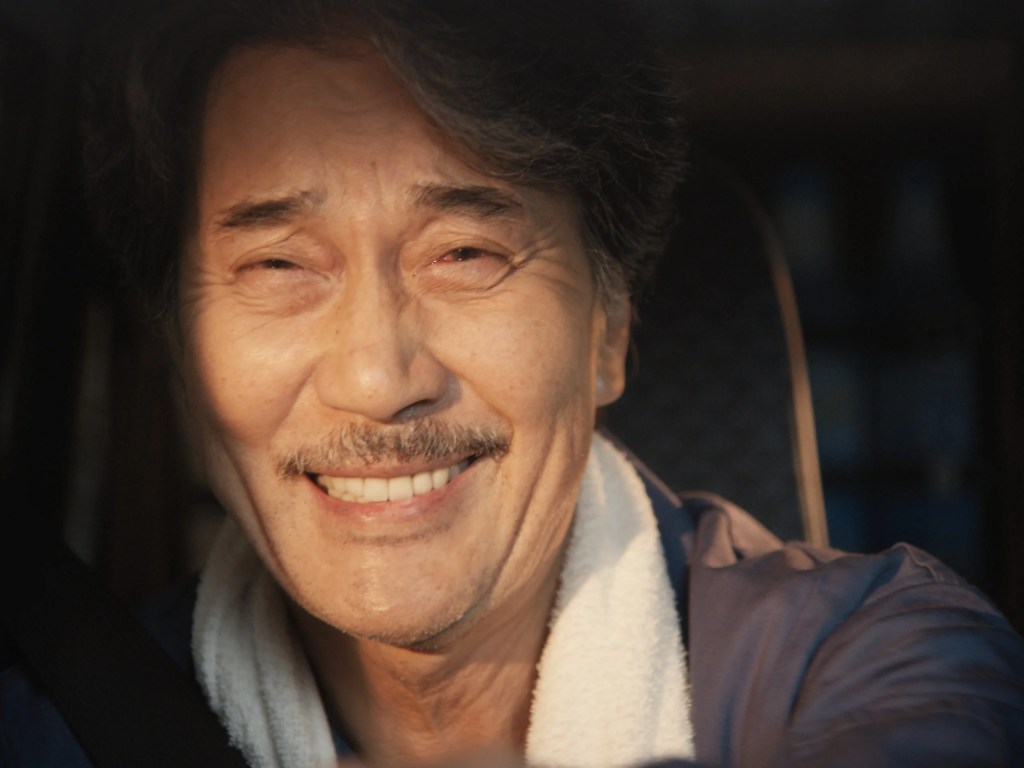
The final scene in this film is one of the best I have ever seen. Our hero drives off into the sunrise, not the sunset, and as Nina Simone’s soulful rendition of “Feeling Good” plays, we are treated to a two minute view of Hirayama as all of the pain and joy and sorrow and happiness of his life plays across his face. Each moment an ephemeral beauty. Like komorebi of the heart.
Why I Recommend It

There is something beautiful and peaceful about Hirayama’s life. It may seem a little dull. It’s certainly simple. It’s routine. And yet, when you watch him go about his days, you feel like taking a deep breath. Or maybe, it’s that you feel like you CAN take a deep breath because the pace of his life gives you room to breathe. And in that, you feel an ache in your heart for room to breathe in your own life.

Hirayama is not a hero on a journey. He is a hero who has arrived at his destination and can now enjoy that peace. He is satisfied and happy in life. It is not stagnant. Like the river that runs through his city, the changes and impacts of the world run through his life and he enjoys them or suffers as they come.

The movie is filled with moments of beauty and joy and I seem to see a new one every time I watch it. How like the life we all live. It is filled with moments of unique and ephemeral beauty, they will never come again, but we are all so busy and hurried and harassed that we fail to notice them. This movie will encourage you to slow down and remember that “next time is next time. Now is now.”

Perfect Days also reminds us that there is no such thing as ONLY perfect days. There are always shadows that fall in our lives but let us not get caught up in the darkness. Let us remember that “weeping may endure for the night, but joy cometh in the morning.” (Psalm 30:5)

For Reflection and Discussion

  • What is good, true, and beautiful in this film?
  • As Christians what can we receive from this film? What can we redeem? What must we reject?
  • Take a day and try to notice the moments of komorebi, both literal and figurative. Write about the moments of unique beauty. How do they point to a loving and sovereign Creator?
  • Reflect/Discuss the ritual of routine. How do rituals in even small, every day things, enrich your life and worship?
  • Reflect/Discuss “Next time is next time. Now is now.” How does this help you live with awareness of God’s sovereignty and love and care for you?
  • What shadows have fallen in your life right now? How can you play in the darkness?
  • Where do you experience shame in your work and life? What is the source of that shame? How does our relationship with God through Christ deliver us from shame?

Next time: MOON

Blessed Silence

For everything there is a season, and a time for every matter under heaven…a time to keep silence and a time to speak. (Ecclesiastes, 3:1,7)

Years ago, when my now grown sons were children, I took them on a homeschool field trip in the Fall to a Civil War historic site. There was a walking trail with multiple stops along the way where you could read about what took place during the battle.

We made our way together along the trail and they took turns reading to us about the events of the battle and we would stare for a moment and try to imagine what it may have looked like before we moved on.

When we climbed a hill I noticed something in the trees and directed my sons to sit down on a bench conveniently placed in front of what I hoped they would see a short distance away.

We sat and I said nothing and, as young boys do, they quickly grew bored and wanted to move on. I asked them to be still and be silent and just watch.

A moment later, my oldest son gasped and pointed through the trees. His brothers were soon gasping and pointing as well as a tree that looked like it was covered in golden leaves suddenly came to life as hundreds of Monarch butterflies spread their wings and began to fly away from its branches leaving them nearly barren. It was truly a beautiful sight and one I will probably never see again.

That sight is what my boys talked about the most over the next day or two. But we all would have missed it if we had not been silent and still.

About this time last year, a friend and I visited a Makoto Fujimura exhibit just a couple of hours from where I live. My favorite piece was one called “Silence” inspired by the novel of the same title by Shusako Endo. The picture below does not begin to do it justice.

We were invited to sit in front of the massive work of art in silence to enjoy it. I have extreme hearing loss so I turned off both of my hearing aids, which reduces me to only 25% of my hearing, and sat in literal silence before that painting.

At first my mind was racing with images I thought I saw and patterns and meaning and then I tried to quiet all of that and just sort of let the beauty of it wash over me. I didn’t try to empty my mind or anything, I just tried to notice and be aware and let the thoughts come without trying to force them.

I am thankful to God for that experience. For BOTH of these experiences. They are a reminder to me that there is a time for silence. There is a time to be still and quiet and open to whatever God wants to do in that moment, even if he is silent himself.

I think we all know there is “a time to speak” but I think we forget that there is also “a time to keep silence.”

But we live in a culture that majors in distraction and noise. It’s everywhere we look. It’s loaded into the device in our hands that is now essentially an extension of our bodies.

Life has been so hectic lately, so stressful, with so many things to do and places to be and things to pay for and goals to achieve and projects to complete. I feel overwhelmed.

Do you?

What I long for is some silence. To just sit with God in a quiet place and see what he will say. Or just sit with God in a quiet place and know I am beloved even when he says nothing.

Why is that so hard for us to do? And I don’t mean finding time to do it, I mean the act itself is hard.

When was the last time you tried to just sit in complete silence for a while?

But what are we missing by chasing and saturating ourselves with noise?

Going to Great Links: June 14, 2025

Here are 7 links to things I enjoyed this week.

I am BAD when it comes to reading the classics of literature, although I am trying to do better. I appreciated this summary of Italo Calvino’s 14 Criteria for What Makes a Classic a Classic.

Here is some wonderfully strange stuff from the David Lynch archives.

Speaking of archives, here is an interesting one: The National Diary Archive, which seeks to preserve “the diaries and letters of the common person.”

Speaking of diaries, here is some fun stuff from Monty Python member Michael Palin on keeping a diary, which he has done for MANY years and has published some that I have enjoyed dipping into.

Here is more stuff from Palin on keeping a diary from an older article in the Guardian, in which he gives practical tips and talks about how diary keeping enriches your life and brings it more into focus.

I enjoyed this little video from author A.J. Harley, Dalek Website Design for Authors.

Poet Malcolm Guite does these wonderful videos where we are a guest in his study and he reads to us from Tolkien while he smokes his pipe.

That’s your 7!

Cold Souls: A Film Christians Should Watch

Welcome to my first post in a new series, FILMS CHRISTIANS SHOULD WATCH.

I was going to begin with the 1992 movie, THE POWER OF ONE, but when I went back to watch it again I discovered that the streaming version does not have English subtitles. I have extreme hearing loss and even with hearing aids in both ears, I must have subtitles on everything I watch. So, I decided to start with what would have been the second film in this series, COLD SOULS starring a personal favorite actor, Paul Giamatti.

***WARNING: THIS REVIEW CONTAINS SPOILERS***

Though you have not seen him, you love him. Though you do not now see him, you believe in him and rejoice with joy that is inexpressible and filled with glory, obtaining the outcome of your faith, the salvation of your souls. – 1 Peter 1:8-9

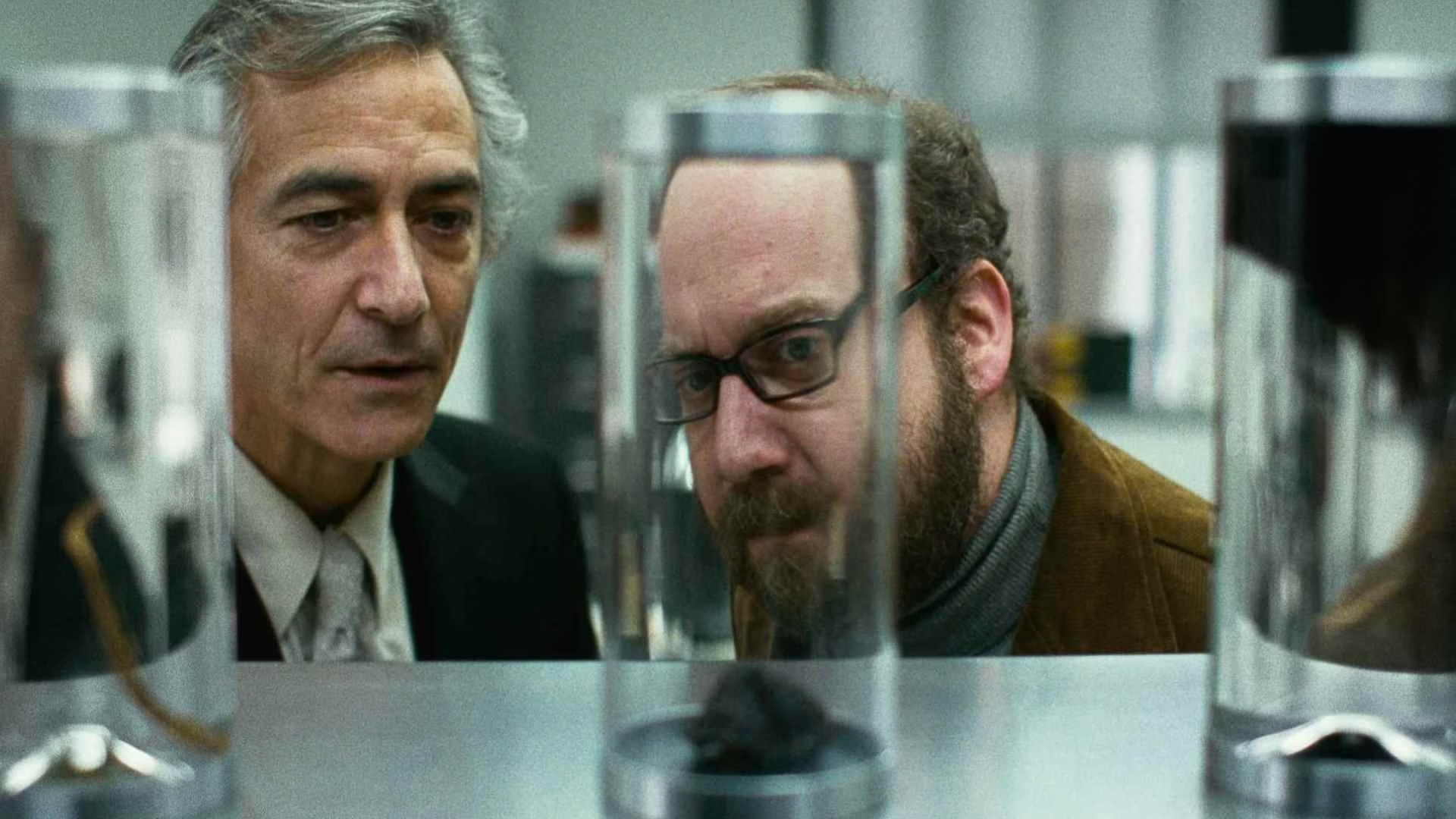
In this film, Giamatti plays a fictionalized version of himself. He is an actor having trouble preparing for the title role in Chekhov’s “Uncle Vanya.” He feels like the role is taking him over. A magazine article recommended by his agent puts him in touch with Dr. Flintstein, who specializes in the extraction and exchange of souls. He decides to have his soul extracted and stored because he cannot carry the burden of it anymore.

This dark comedy is surprising in so many ways. The premise is absurd and yet the implications are profound.

When Paul first visits Dr. Flinstein (played by David Strahairn) he is struggling with the idea of removing his soul and what it might do to him. The doctor promises that Paul will be happy if he has his soul extracted and Paul responds, “I don’t need to be happy! I just don’t want to suffer.” And that’s really what it comes down to, to have a soul is to suffer. Or, perhaps it’s more accurate to say that we store suffering in our soul.

The whole exchange between Paul and Flinstein is funny, with several laugh-out-loud moments, including one where the doctor offers Paul a cheaper option by storing his soul in New Jersey. “No! I do not want my soul shipped to New Jersey.” Paul says. “I don’t blame you.” The doctor replies.

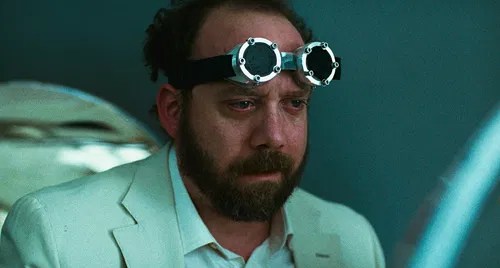
Before the procedure, Flinstein offers him the opportunity to put on a pair of goggles that will allow him to “take a look inside” his own soul. Paul is adamantly opposed to the idea. You can see the fear on his face (Giamatti is a master at nonverbal expressions of incredible depth) but the fear is not around the procedure itself, there is something deeper going on.

This is confirmed when his soul is extracted into a jar and he is afraid to see what it looks like. When he finally looks at it, he is horrified to discover that it has the appearance of chickpea. This is a hilarious scene I won’t spoil for you but the doctor has explained to him that the appearance of our souls can take many different forms. Interestingly he notes that people assume souls would look bright and colorful and dynamic but that most of them are darker, especially gray. He points to one example, a black gelatinous blob, which he says is from a famous actor. “I believe he had a melanoma.” The doctor said. Not his body, his soul, we are led to believe.

The story shifts to another character, Nina (played by Dina Korzun) who is a soul mule for the Russian mafia. She carries people’s souls in her own body to the United States. These souls are from “anonymous donors”, which is a euphemism for poor people who are literally selling their souls for money and their souls are brought to the U.S. where they can be rented by rich people.

When Paul returns to his life with 95% of his soul missing–there is always a fragment left behind–he discovers that he feels nothing. He is not suffering, which was his goal, but he also cannot empathize, he cannot connect with his wife or anyone else, he also cannot act, or live in any meaningful way.

He returns to Flinstein and rents the soul of a Russian poet to help him with his performance in UNCLE VANYA and turns in an intense and wonderful performance the audience loves. But the soul of this poet is too much for him to manage. It turns out that souls carry memories and emotions. By carrying the soul of this poet, he feels what she felt and at the depth she felt it. He sees life through her eyes and he realizes, as he tells Flinstein that “this soul needs a much bigger life than mine…she has a beautiful soul. She should not have done it (given it up).” And in that he realizes that he should not have given up his either.

He decides that he wants his soul back but when he goes to retrieve it from the locker where it is stored, the locker is empty. It turns out that Nina stole Paul’s soul to take back to Russia because the wife of her boss wants the soul of an American actor to help with her acting career. Paul’s is the only one in the database so she takes it back to Russia and tells her mafia boss that it is the soul of Al Pacino.

When Paul finds out, he finally has to admit to his wife what he has done. It’s a beautifully acted scene in which Paul claims that he did a “silly, selfish thing” by giving up his soul and now he must go in search of it with Nina, who is committed to helping him because after carrying his soul to Russia and watching some of his movies feels guilty for stealing his soul and wants to help him get it back.

How interesting that giving up your own soul is a “selfish” thing. Could it be that our souls do not belong to us? That they are not ours to give away or to remove?

When Paul confronts the Russian gangster to get his soul back he discovers, to his horror, that the woman with his soul is in a soap opera. “You’re going to ruin my soul!” He says. And when he finally does, with Nina’s help, extract his soul from the actress, he finds that it is all dried out. The actress was indeed ruining his soul.

When they try to put his soul back into his body, Nina says that his soul is resisting the return and that he must reconnect with it by looking inside, which is what he has wanted to avoid from the start. When he does, it seems that his worst fears are realized. It looks like his soul is empty.

He soon discovers that it is actually filled with all of the events and people that have made him who he is. There is pain there to be sure. There is darkness and loneliness and suffering. And there is also love and connection and beauty and joy. To regain his soul, he must embrace all the burdens he started out trying to rid himself of.

Why I Recommend It

This film is strange in all the best ways. It asks questions about who we are as human beings without being heavy-handed or by preaching. It just tells an amusing story that is also tender and heavy without being sappy and burdensome.

I find it fascinating that writer/director Sophie Barthes suggests that we do in fact have souls, and that our souls are somehow influenced, changed, built, enriched, and corrupted, by the people, experiences, and choices of our lives. And that without the pain and suffering in our lives, we cannot know joy and happiness nor can we connect with and relate to others.

In one sense, the film suggests that we are the savior of our own souls but then, Paul is helped by Nina who carried his soul within herself for a while. This is a hint that maybe we need something or someone outside of ourselves to save our soul when it is lost.

Certainly, the film celebrates the ways in which our souls are enriched by the people we love and that love us and that connecting with people who have beautiful souls makes our souls more beautiful as well.

It also asks us to accept that suffering is not pointless and that the weight of our suffering is not a burden to rid ourselves of but something to embrace as a force that shapes us.

There is a lot of beauty in this film. And it’s funny and tragic in turns. Giamatti turns in a stellar performance and the script is well written and in many ways, profound. There are themes of faith, redemption, and a belief that our lives have meaning and significance. As a Christian, I see echoes of the faith in this movie.

Reflection and Discussion Questions

If you choose to watch COLD SOULS, here are some questions for reflection and/or discussion.

  • What is beautiful about this film? What is true? What is good?
  • As Christians, what can we receive in this film? What can we redeem? What must we reject?
  • What does this film say about the nature of human beings and how does that compare with what the Scriptures say?
  • If you could “take a look inside” your own soul, what do you think you would see? What would you be afraid to see?
  • In what ways has God used suffering to shape you? How does it help you connect with others? What can you be thankful for there?

Next week…PERFECT DAYS.

Going to Great Links: June 7, 2025

A new (hopefully weekly) feature on my blog where I share 7 of the best links I found on the internet that week.

I enjoyed this peek inside Austin Kleon’s pocket notebook. Kleon is a lot of fun to follow and read. He introduced me (and many others) to blackout poetry, which I have tried my hand at a few times.

I also had fun looking at the 50-year journaling habit of style guru Raymond (who is now 80) in this newsletter from Viv Chen. I absolutely love learning about how people journal and keep notebooks.

And, to continue on journaling, This article from Art of Manliness talks about microjournaling as a replacement for doom scrolling.

The trailer for Wes Anderson’s latest film, The Phoenician Scheme has me really excited. I love his movies.

Another trailer and film I am excited about is The Life of Chuck, which looks like it could be as delightful as all the hype says it is.

And the star of Life of Chuk, Tom Hiddleston shares his top 4 (current) favorite films on this little video from Letterboxd.

And while we are on the subject of art, you might want to give this article from Law and Liberty a read: What is Public Art For?

That’s your 7!

Films Christians Should Watch

I’m starting a new regular feature on the blog called Films Christians Should Watch.

The idea came from a Letterboxd List I curate (if you are on that platform, please connect with me there). And the list is based on this quote from Alan Noble in his book DISRUPTIVE WITNESS:

Christians should choose aesthetically excellent stories, whether or not they are the most popular. These stories will tend to be darker or more depressing or heavy, which sounds unpleasant. But Christians should be known for their appreciation of tragedies, because in good tragedies we must reckon with our place in the world, the problem of evil, and the struggle of meaning…We do not need to only participate in dark or troubling stories, but we do need to give priority to stories that unsettle us, and expand us, whether through beauty and delight or tragedy.

Each Friday I will review one of the movies from my list and recommend some resources and discussion/reflection questions to help you think about the film in deeper and more meaningful ways as a follower of Christ.

I am beginning this new project because of Jeffrey Overstreet’s book THROUGH A SCREEN DARKLY, which I highly recommend.

Next week, I will begin with the first film on the list THE POWER OF ONE. I am looking forward to viewing it again and writing about it. I may not go down through the list in order, but this is a nice place to start.

I hope you will join the conversation by making comments and recommending movies you think Christians should see.

Paying Attention to Meaning in Art

“Things mean things.”

That’s what Jeffrey Overstreet‘s high school English teacher taught him about poetry and literature and films and art and he has carried that lesson with him as a movie critic and author and teacher.

Objects and words and images have meaning. Sometimes the creator uses them intentionally to convey specific ideas or truths, and at other times, the meaning is personal to the one who is engaging with the art. The work speaks to us in ways the creator may never have intended, but we get the message nonetheless.

Years ago, I visited an Annie Leibovitz photography exhibit at the High Museum of Art in Atlanta. I only remember one portrait. It’s the one in the White House of members of the Bush Administration’s war time cabinet. Something in that portrait jumped out at me and I couldn’t take my eyes off of it.

It was a band-aid on the thumb of Donald Rumsfeld.

The way his hand is positioned in the portrait told me I was MEANT to see the bandage. Leibovitz seemed to be saying “look at this!”

Here was this huge portrait of some of the most influential and powerful people on the planet at that time and one of them had a boo-boo. The meaning, to me at least, was that these are human beings, just like me. They are fallible and weak and easily injured, just like me.

It was a powerful experience with art and one I hope I never forget.

As a Christian, I believe that Scripture is the only infallible source of authority for faith and practice. I also believe God’s voice can be heard in art and nature and through others. God, the ultimate Creator, speaks through the creations of his image bearers. But we have to be curious and we have to engage and we have to slow down and pay attention. We have to remember that things mean things and that requires something of us, some effort to discover the meaning.

Works of art, whether a novel or painting or a play or anything else, has an impact on the way we see ourselves and the world and maybe even God. As Paul Klee says, “Art does not reproduce what we see; rather, it makes us see.” And I would add that it broadens and deepens and changes what we see and HOW we see.

But we have to pay attention.

In his excellent book, THROUGH A SCREEN DARKLY, Overstreet talks about “the God Room”. That’s what Hollywood people call the room where they meet with the Christian journalists and movie critics. At first it was an insult but those who have been in the God Room with these believers have discovered that they often have the deepest and most profound conversations about art there.

That’s because Christians see the world differently. We are looking for God and truth in what we see on the screen and when we see it, we point it out and ask meaningful questions about it. And in doing so, these Christian film critics have often shown the artists themselves something they didn’t realize was in their own work.

When was the last time you engaged art looking for the voice of God?

Change the way you see.